
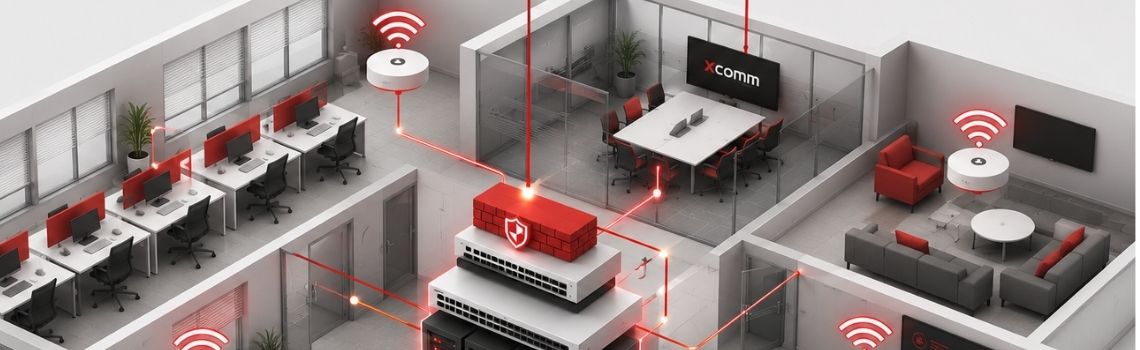
Good business network design is one of the most important foundations for a modern organisation, yet it is often overlooked until something goes wrong. A business may have fast broadband, modern computers and cloud-based applications, but if the network connecting everything together has not been properly designed, performance, security and productivity can all suffer.
As we discussed in our previous blog, your network needs to keep pace as your business grows. More employees, more devices, cloud applications, hybrid working and multiple locations all increase demand on your infrastructure.
But building a network that can cope with growth isn’t simply a question of buying faster equipment. Good business network design starts with understanding how the organisation actually works, what it needs today and where it is likely to go next.
What is business network design?
Business network design is the process of planning how your network infrastructure will work as a complete system.
It covers much more than choosing switches and wireless access points. A properly designed network considers connectivity, security, capacity, resilience, users, devices, applications and future expansion.
The aim is to create infrastructure that is:
- Reliable
- Secure
- Scalable
- Cost-effective
- Easy to manage
- Appropriate for the way your business operates
This is why network design should happen before equipment is purchased or installed.
Why business network design should start with the business
There is no single network solution that is right for every organisation.
A professional services business with a single office will have very different requirements from a company operating across several sites, supporting remote workers or running critical applications from the cloud.
Good business network design therefore starts with questions such as:
- How many people need access?
- Where do they work?
- Which applications are business critical?
- How many devices are connected?
- How much traffic does the network handle?
- What happens if the primary internet connection fails?
- How much growth is expected?
- What security requirements need to be met?
Understanding these requirements means the resulting network is designed around the business rather than the other way around.
Business network design needs to consider growth
One of the most common mistakes is designing a network for the organisation that exists today rather than the one it expects to become.
Imagine a business has 30 employees today but expects to reach 50 over the next few years.
A network designed purely around the current headcount may quickly run into capacity issues. Additional switches, wireless access points, cabling and connectivity may be required sooner than expected.
Good business network design considers future requirements from the outset. That doesn’t mean buying everything you might possibly need. It means creating a sensible architecture that can be expanded without having to start again.
WiFi needs more than good coverage
Business WiFi is another area where design makes a significant difference.
Simply placing an access point wherever someone experiences a weak signal does not necessarily create a good wireless network. A properly designed business WiFi solution considers both coverage and capacity. The network needs to cope with the number of people using it, the number of devices they carry and the applications they use.
A meeting room, for example, may require considerably more capacity than a quiet storage area. A busy reception area may have dozens of devices connecting at the same time.
Good business network design takes these differences into account.
Security should be designed into the network
Network security should not be something added after the infrastructure has been installed. It needs to form part of the design from the beginning.
Different types of users and devices may need different levels of access. Guest WiFi should not provide unrestricted access to business systems. CCTV, access control and other connected devices may also need to be separated from the main business network.
Network segmentation can help control how different systems communicate and reduce unnecessary exposure. Firewalls, secure remote access, authentication and appropriate access policies can then be incorporated into the wider network architecture. This is particularly important as businesses increasingly rely on cloud applications and remote workers.
Connectivity is part of network design
A business network doesn’t operate in isolation.
The connection between your premises and the internet can be just as important as the infrastructure inside the building. A company may have an excellent internal network but still experience problems if its internet connection doesn’t provide sufficient bandwidth, reliability or resilience.
For businesses where connectivity is critical, it may be worth considering dedicated internet access, additional circuits or other resilient connectivity options.
Xcomm provides a range of business-grade connectivity solutions, including fibre broadband, dedicated internet access and higher-bandwidth circuits, with options for resilient connectivity via alternate circuit routing or even Satellite.
The important point is that connectivity should be considered as part of the overall network architecture rather than as a completely separate purchase.
Multi-site businesses need a different approach
Connecting several offices together creates another layer of complexity.
Users need secure access to shared applications and resources, while businesses need visibility and control across the entire network. A multi-site environment also needs to consider how traffic travels between locations, how each site connects to the internet and what happens if one connection fails. Technologies such as SD-WAN can provide businesses with intelligent, secure and centrally managed connectivity across multiple locations.
Xcomm provides multi-site networking solutions designed to connect offices and remote workers while maintaining visibility and control.
Resilience should be part of the plan
A network can be fast and secure but still represent a major business risk if one failure brings everything to a halt.
Business network design should therefore consider what happens when something goes wrong.
- What happens if the internet connection fails?
- What happens if a firewall develops a fault?
- What happens if a switch fails?
- What happens if the office loses power?
The appropriate level of resilience depends on how critical the network is to the organisation. For some businesses, a secondary internet connection may be sufficient. Others may require more comprehensive business continuity and disaster recovery arrangements.
The objective isn’t necessarily to eliminate every possible point of failure. It is to identify the risks and decide what level of protection makes commercial sense.
Managed network design can reduce complexity
Once the network has been designed and installed, it still needs to be maintained.
Hardware requires updates. Security policies need reviewing. Capacity needs monitoring. New users and devices need adding.
This is where managed networking can provide significant value.
Xcomm offers managed networking and Network as a Service, where its engineers monitor and manage network infrastructure using cloud-based networking architecture. The service is designed to provide scalability, ongoing management and access to current security technology without requiring the customer to manage the entire infrastructure themselves.
For businesses without extensive internal networking expertise, this can provide a practical way to maintain a high-performing infrastructure as requirements change.
Good network design can save money
It might seem that careful planning adds cost, but the opposite can often be true.
Poor design can result in:
- Replacing equipment prematurely
- Installing unnecessary hardware
- Paying for inadequate connectivity
- Repeated WiFi fixes
- Unplanned downtime
- Expensive emergency upgrades
A properly designed network considers the whole environment before decisions are made.
That can help businesses invest in the right infrastructure rather than repeatedly paying to correct problems later.
How Xcomm approaches business network design
Xcomm’s network design service is based around understanding the specific requirements of each organisation.
Its engineering team designs multi-vendor network solutions, from partners including Cisco, Cisco Meraki, FortiNet and Ubiquiti, with a focus on reliability, scalability, cost-effectiveness and flexibility.
That can include everything from network infrastructure and connectivity through to security, remote access and multi-site networking.
The result should be a network that works quietly in the background, allowing employees to access the systems and information they need without constantly thinking about the infrastructure supporting them.
Is your network designed for where your business is going?
If your business has grown significantly since your network was installed, it may be time to look at the infrastructure again. Perhaps you have more employees, more connected devices, additional locations or a greater reliance on cloud applications. Perhaps you’re planning an office move or expansion. Or perhaps your network seems to work reasonably well but you have no idea whether it is secure, scalable or resilient enough for the next stage of your business.
A network review can provide a clearer picture of where you are today and what needs to change.
Good business network design isn’t about buying the most expensive equipment. It is about creating the right infrastructure for your organisation, with the flexibility to adapt as your business develops.
At Xcomm, we design, implement and manage business networks that are built around the requirements of the organisation, rather than simply selling a collection of networking products.
To discuss your requirements, call 03333 447 092 and speak to the Xcomm team.
You can also explore business connectivity options through Xcomm’s sister brand, Linebroker.